
Kitesurfing Madagascar: The Complete Guide to Spots and the Destination
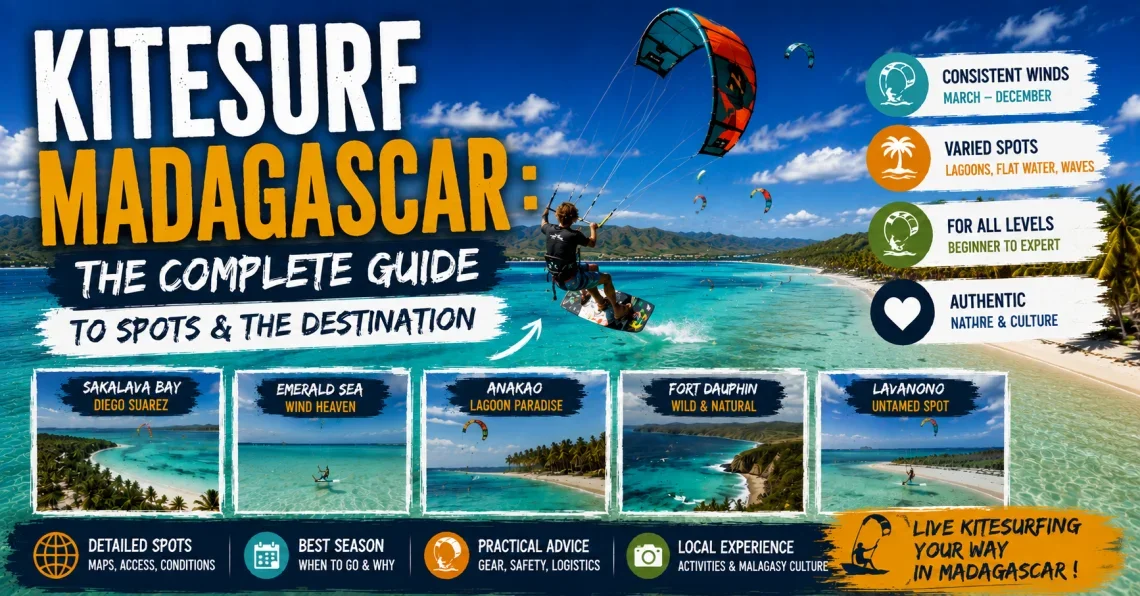
This article is written by the founder of Madakitecamp, an IKO-certified kitesurf instructor based at Sakalava Bay, Diego Suarez, since 2012. Madagascar has several recognized kitesurf spots, all very different from one another in terms of wind, skill level required, and infrastructure. Here's a complete and honest overview, with a detailed focus on the North, the region we operate in day to day.
Where can you kitesurf in Madagascar?
Madagascar offers kitesurf spots along most of its coastline, mainly concentrated in the North (Sakalava Bay and Babaomby/Emerald Sea, near Diego Suarez), the Southwest (Anakao, near Tuléar), and the far South (Fort Dauphin and Lavanono). The general wind season runs from April to November across most of the island, with a peak between June and October depending on the region.
Sakalava Bay and Babaomby, the reference spots of the North
Sakalava Bay, 20 km from Diego Suarez, and Babaomby (Emerald Sea), right nearby, form the most reputed kitesurf zone in Madagascar. The wind, known as the Varatraza, a south-east trade wind amplified by a cape effect and a venturi effect, blows from mid-March to late November/early December, peaking between June and September, regularly reaching 25 to 35 knots in high season across the whole zone. But these two spots, despite being neighbors, suit very different profiles.
Sakalava Bay, the spot to progress safely
At Sakalava Bay, beginner lessons are given at low tide, over a sand and seagrass bottom with no hazards, in waist-deep water, with side-shore wind that always carries riders back to the beach. This setup allows full control and maximum safety, making it a spot suited to beginners as well as intermediate and advanced riders, who benefit from a wide, open playground to progress at their own pace without depending on nautical assistance. It's also the best-equipped zone: IKO-affiliated schools, gear rental, and on-site accommodation.
The Emerald Sea (Babaomby), the spot for confirmed riders
The Emerald Sea, at Babaomby, is a stunning but noticeably more technical spot. Beaches are almost nonexistent, and the seabed is scattered with coral heads, requiring an already solid level to ride safely. Unlike Sakalava Bay, a rider who fails to go upwind can't simply walk back: rescue by jet ski or boat is needed. It's therefore a spot reserved for confirmed riders capable of managing their own navigation, rather than beginners or riders still progressing.
To help plan your trip to the region, our article on [how to get to Diego Suarez] covers flight and transfer options, and our guide to [things to do in Diego Suarez] gives you plenty to enjoy in the region beyond kitesurfing.
Anakao, the Southwest spot
Anakao, a fishing village near Tuléar, is known for its flat lagoon suited to learning and freestyle, as well as more committed waves outside the reef for confirmed riders. Wind here generally blows between 20 and 30 knots from April to mid-November, with the best period reportedly around June to October according to local sources.
One thing worth checking on-site: wind direction varies through the day, generally off-shore but shifting orientation once the thermal wind kicks in. This is important to confirm directly with a local school before riding, especially at a beginner level.
Fort Dauphin and Lavanono, the wild South for confirmed riders
Fort Dauphin
Fort Dauphin, in southeastern Madagascar, is known for a varied playground ranging from flat water to medium and large waves, mostly over a sandy seabed. What sets the area apart is the surrounding terrain, which accelerates the wind through the nearby mountain ranges, somewhat similar to the venturi effect found at Sakalava Bay. According to riders and local operators, the wind season follows the general pattern of the south of the island, broadly from June to October.
Lavanono
Lavanono, at the southernmost tip of Madagascar, is an isolated fishing village, reportedly home to one of the island's finest left-hand waves, long, powerful, and rarely crowded. Wind blows between 15 and 30 knots from July to November, with the best sessions typically in the morning and late afternoon. This is clearly a destination for confirmed riders chasing waves and committed conditions, rather than a place to progress or learn. Isolation comes at a cost of comfort too: very limited network coverage and electricity on-site, requiring genuine logistical preparation ahead of the trip.
Both areas remain far less developed in terms of infrastructure than the North, and are best suited to already experienced kitesurfers rather than beginners or families.
What about Nosy Be?
Contrary to a common assumption, Nosy Be is not a kitesurf spot. The island, popular for classic beach tourism, has neither suitable wind nor a recognized spot for the sport. If kitesurfing is your main priority, it's better to focus your trip on the North (Sakalava Bay, Babaomby) or the Southwest (Anakao).
Quick spot comparison
- Sakalava Bay (North): very reliable wind (25-35 knots in high season), suited to all levels including beginners, strong infrastructure with IKO-affiliated schools.
- Babaomby / Emerald Sea (North): same wind zone as Sakalava, but a technical playground (little beach, coral heads), reserved for confirmed riders, boat rescue required.
- Anakao (Southwest): steady wind (20-30 knots), lagoon for learning and waves for confirmed riders, wind direction varies through the day, worth checking locally.
- Fort Dauphin (Southeast): varied playground from flat to big waves, wind accelerated by terrain, June to October season, confirmed level recommended.
- Lavanono (Far South): 15-30 knot wind from July to November, left-hand wave regarded as one of the island's finest, very isolated, minimal infrastructure.
- Nosy Be: no kitesurf spot, skip it if kiting is your priority.
So, which spot should you choose?
For a beginner or a rider looking to progress safely, Sakalava Bay remains the most reliable choice on the island: it has the most consistent wind in Madagascar, a protected playground that allows real control in complete safety, and the most developed infrastructure (schools, accommodation, gear) on-site. For a confirmed rider chasing waves and looking for more adventure, the Emerald Sea, Anakao, or the wild South (Fort Dauphin, Lavanono) offer more committed, less crowded conditions.
Continue planning your trip
To go further on the Diego Suarez region, our [wind and season guide] breaks down the calendar month by month, our article on [learning to kitesurf] answers the question of how long it takes to progress, and our [budget guide for a kitesurf trip to Madagascar] helps you estimate your costs.
Book your kitesurf trip in the North
Based at Sakalava Bay since 2012, we know this region inside out. Contact us to plan your kitesurf trip according to your level and your dates.


 WhatsApp
