
What to Do in Diego Suarez? The Complete Local's Guide
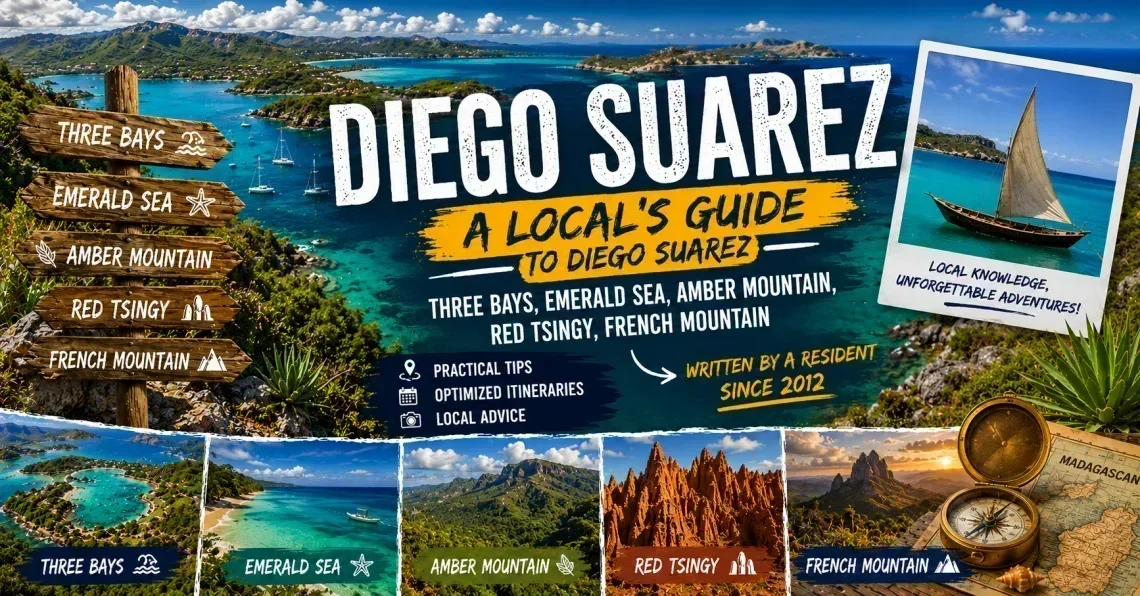
A guide written by those who live here
Diego Suarez (Antsiranana) is far more than a stopover on the road through northern Madagascar. It sits on one of the world's most beautiful bays, surrounded by an unusually diverse range of natural sites packed into a small area: karst formations, tropical rainforest, wild beaches, turquoise waters. In a single week here, you can go from a morning kitesurf session to a forest full of lemurs in the afternoon, then watch the sun set over red rock spires the next day.
This guide wasn't written from a desk. We've lived and worked on Sakalava Bay since 2012, we know every site listed here from taking guests there dozens of times, and we also know exactly when the wind blows and when it doesn't, which changes everything when planning a trip here. Here's our selection, organized by proximity and built to help you make the most of your time on the ground.
The Three Bays: Sakalava, Pigeons and Dunes
The Three Bays make up one of the finest coastal hikes in the region, and they're also our home turf. Sakalava Bay, Pigeons Bay and Dunes Bay follow one another along a coastal trail accessible on foot, with a new landscape at every turn: sand dunes, cliffs, turquoise water, and the dry scrubland typical of northern Madagascar.
The hike between the three bays
Plan for around 2 to 3 hours of walking to link all three bays, on terrain that's generally easy but with a few sections along cliff edges above the ocean. The best time to start is early morning, before the heat sets in, or late afternoon for the low light over the dunes. Bring water: there's no place to restock along the route.
Why Sakalava Bay is THE kitesurf bay of the North
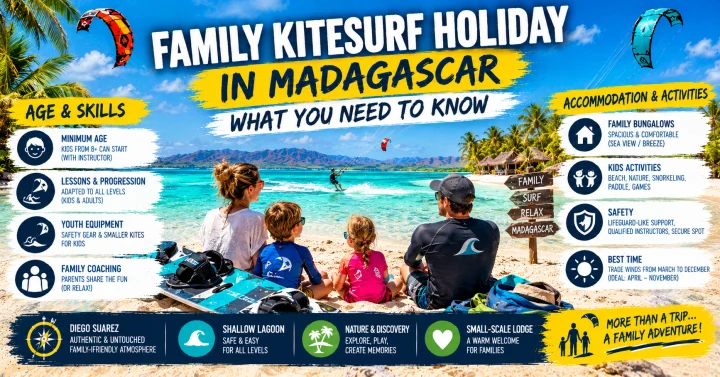
Sakalava Bay benefits from a thermal wind reinforced by the trade winds from March to December, particularly steady from May to October, with a water area large enough to progress safely whether you're a beginner or already into freestyle or wave riding. This combination, reliable wind, a safe spot, and an unspoiled natural setting, is what made this bay a reference spot across all of northern Madagascar, well beyond Diego Suarez itself.
Best viewpoints and photo spots
The elevated viewpoint between Sakalava Bay and Pigeons Bay offers the most complete view over the whole coastline. Dunes Bay, with its wind-sculpted sand formations, is the most photogenic site in the area, especially late in the day when the light turns golden.
Montagne des Français (French Mountain)
This limestone massif overlooking the city and the bay to the east is a must for anyone who wants to grasp the geography of the place in a single outing, without giving up a whole day to it. It's only 20 minutes' drive from Sakalava Bay to the foot of the massif, making it one of the most accessible sites on this list.
The climb
Reaching the summit takes around 1.5 to 2 hours round trip depending on pace, on a well-marked but rocky trail. No technical difficulty, but sturdy shoes are needed.
Panoramic views and endemic baobabs
From the summit, the view takes in the entire Bay of Antsiranana, one of the largest natural bays in the world. The reserve is also home to Adansonia suarezensis, a baobab species endemic to this single region of northern Madagascar, found nowhere else on the island.
The smart move
This is the perfect half-day excursion: short, physically undemanding, and only 20 minutes' drive from Sakalava Bay, ideal for a rest day or a windless morning without giving up the rest of your day.
The Emerald Sea
About twenty minutes by boat from the fishing village of Ramena, the Emerald Sea takes its name from the striking colour of its shallow lagoon, protected by a sandbar. Ramena itself is only 20 minutes' drive from Sakalava Bay, but plan for this excursion to take up nearly a full day: the return to Sakalava is usually around 5pm.
Trip logistics
Departure is by motorized pirogue from Ramena beach. The sail goes up as soon as the boat reaches the windy zone, about 5 minutes after departure, then figure on 45 minutes of sailing to reach Suarez Island. Lunch is served on Suarez Island, in the middle of the lagoon, in the shade of small huts set on a white sand beach lined with coconut trees, one of the most photogenic settings in the entire region.
Best time to go
The water is clearest at the start and end of the trade wind season, between March and May and again between November and December, when the sea is calmest. Avoid the cyclone period (January to March), when boat trips are often cancelled for safety reasons. Note that the return crossing can get fairly rough between May and October, since you're sailing against the wind and chop.
Combine with Ramena
Ramena village is worth the detour in its own right: genuine fishing village atmosphere, a few good beachfront restaurants. It's a natural stop before or after the boat trip, not just a logistical starting point. Worth noting: every Sunday is party day in Ramena, with a lively crowd and music all along the beach for anyone who wants to experience the village at its liveliest.
Amber Mountain and Red Tsingy: The Day to Optimize
Here's the tip most guides don't give you, and it genuinely changes how you plan a trip: Amber Mountain and the Red Tsingy can be visited in the same day. Most visitors treat these as two separate excursions on two different days. That's an unnecessary waste of time and money: both sites sit along the same road south of Diego.
Amber Mountain in the morning
This national park, the first ever created in Madagascar, protects a high-altitude tropical rainforest in complete contrast to the dry coastal landscape. It's known for its waterfalls, crater lakes, an impressive diversity of chameleons (including the tiny Brookesia leaf chameleons), and several lemur species, including the crowned lemur. The cool climate makes it a pleasant excursion even at the height of the dry season. Plan for half a day for a comfortable visit with a local guide, mandatory inside the park.
Red Tsingy at sunset
The Red Tsingy is a unique geological formation: spires of eroded laterite, red and orange, shaped by erosion rather than the limestone found in the better-known tsingy of southern Madagascar. The low light at the end of the day brings these formations to life, bringing out every shade of red and orange in the rock. It's by far the best time to photograph the site, far better than the flat midday light.
The optimized itinerary
Leaving Diego early in the morning, the most efficient sequence is: Amber Mountain in the morning, lunch in Joffreville, then the Red Tsingy in the late afternoon for sunset, before heading back in the early evening. A single transfer, a single day of vehicle and guide, instead of tying up two full days for two separate excursions. This is the format we consistently recommend to guests who want to make the most of their time on the ground without giving up either site.
In Summary
Diego Suarez is best experienced by alternating water sports with exploring on land: the Three Bays and Montagne des Français (20 minutes' drive) for windless mornings, the Emerald Sea (Ramena, also 20 minutes away) for a full day at sea with lunch on Suarez Island, and the Amber Mountain / Red Tsingy combination for one complete, optimized day. A week-long stay in Diego gives you plenty of room to combine kite, wing or windsurf sessions on Sakalava Bay with exploring these sites, without ever feeling like you're racing against time.
Before finalizing your itinerary, make sure your dates fall in the right window: our [wind and season guide] breaks down wind strength, water temperature, and crowd levels month by month. And if your travel plans aren't locked in yet, our article on [how to get to Diego Suarez] covers every flight and transfer option to Sakalava Bay.



 WhatsApp
